FMCG Supply Chain Training for Enterprise Teams
FMCG supply chains operate at speed. Demand fluctuates constantly, product lifecycles are short, and retailer expectations leave little room for error.
Skill Dynamics helps supply chain teams build the capability to improve forecasting, strengthen operational decision-making, and drive consistent performance across global supply networks. Through structured, role-based learning, we help organisations develop supply chain capability at scale.

Request a consultation with a supply chain learning specialist!
Get in touch with the team.Fast-Moving Demand. Constant Operational Pressure
FMCG supply chains operate in environments where consumer demand can shift rapidly, retailer expectations are high, and service failures quickly impact revenue and brand performance.
Teams must balance forecast accuracy, inventory availability, supplier performance, and logistics efficiency while responding to changing market conditions. At the same time, cost pressures, supply disruption, and global sourcing complexity continue to increase operational risk.
For many organisations, the challenge isn’t visibility. It’s maintaining consistent, high-quality decision-making across planning, inventory, logistics, and supplier management.
Where Supply Chain Capability Breaks Down
Most supply chain teams don’t struggle because they lack systems. They struggle because decision-making capability is inconsistent.
Forecasts vary in accuracy between teams. Inventory decisions are made using different assumptions. Supplier issues are identified too late, and operational knowledge becomes fragmented across regions and functions.
Over time, this creates a gap between planning and execution. Inventory costs increase, service levels become harder to maintain, and supply chain performance becomes increasingly difficult to improve at scale.
The Skill Dynamics Supply Chain Academy
A structured, enterprise-ready approach to building supply chain capability across global teams.
Unlike traditional supply chain training, the Skill Dynamics Academy is designed to develop consistent decision-making capability across roles, regions, and operational environments, not just deliver isolated courses.
Trusted by global supply chain teams to build capability consistently at scale.
Role-Aligned Learning Pathways
Training is aligned to specific supply chain roles, including planners, buyers, logistics managers, and supply chain leaders. Each pathway focuses on the decisions individuals are responsible for every day.
Competency-Based Curriculum
The curriculum is structured around core supply chain capabilities, helping teams develop the skills needed to improve planning, inventory management, supplier performance, and operational execution.
Applied, Scenario-Based Learning
Teams learn through realistic FMCG supply chain scenarios, including demand fluctuations, inventory challenges, supplier disruption, and service-level pressures. The focus is on application, not theory.
Continuous Updates & Reinforcement
Supply chain conditions evolve constantly. Training is continuously updated to reflect changing market conditions, operational challenges, and emerging risks, with reinforcement built in to sustain capability over time.
Explore how this could work in your organization.
Learn More.Core FMCG Supply Chain Competencies
High-performing FMCG supply chain teams aren’t built on systems alone. They’re built on structured capability across planning, logistics, inventory management, and operational decision-making.
These capabilities work together to improve service levels, increase responsiveness, and maintain control across fast-moving supply chain environments.
Transportation and Logistics
Teams learn how to keep the full cycle moving: promising, scheduling, shipping, invoicing, without missing a beat.
Supply Planning
When supply doesn’t match demand, everything slows down. This competency helps teams plan smarter, from scheduling production to managing distribution networks, so they can stay one step ahead.
Sustainability
Sustainability isn’t a bolt-on; it’s built into the decisions teams make daily. This competency helps learners reduce environmental impact while keeping supply chains resilient and aligned to ESG goals.
Warehousing
A good warehouse setup makes everything else run smoother. We help teams improve layouts, stay accurate, and run safer, more efficient day-to-day operations.
Order Management
It’s not just about getting the order, it’s everything that follows. Teams learn how to keep the full cycle moving: promising, scheduling, shipping, invoicing, without missing a beat.
Project Management
From planning to execution, this module builds the skills needed to lead supply chain initiatives. Teams learn how to scope projects, build time plans, manage risk, and create business cases that get buy-in.
Strategy
Go beyond firefighting. Using the SCOR framework and real-world case examples, learners develop the tools to design high-performing supply chain strategies that drive sustainable, long-term value.
Procurement
Procurement and supply chain can’t work in silos. We show teams how to build better connections between sourcing and operations so the right things show up at the right time, from the right suppliers.
Manufacturing
Understand the processes and strategies that define modern manufacturing. From production environments to supply chain design impacts, this module connects factory-floor reality with broader planning decisions.
Legal Training
No supply chain professional operates in a vacuum. This module builds confidence in handling contracts, navigating compliance, and understanding the regulations that shape procurement and operations.
Inventory Management
Stock too much, and you waste money. Stock too little, and you lose sales. This module teaches teams how to strike the right balance.
Finance
Demystify the numbers behind supply chain performance. From P&L accounting and total cost of ownership to inventory valuation and the cash-to-cash cycle, this module gives learners the financial fluency to drive better decisions.
Demand Planning
Get to grips with forecasting methods, managing uncertainty, and integrating demand signals into sales and operations planning. Teams learn how to build reliable plans that hold up under pressure.
Analytics
Learn how to turn data into decisions. This module covers the analytics strategies supply chain professionals need to spot trends, increase efficiency, reduce costs, and build a real competitive edge.
Enterprise Delivery & Oversight
Building supply chain capability is one thing. Delivering it consistently across a global organisation is another.
The Skill Dynamics Supply Chain Academy is designed for enterprise deployment, giving organisations full visibility and control over how capability is developed, measured, and sustained.
Deployment Across Global Teams
Deliver consistent training across regions, sites, and supply chain functions, ensuring alignment in how operational decisions are made.
Skills Diagnostics & Benchmarking
Assess current capability levels, identify gaps, and prioritise development areas based on operational requirements and business objectives.
Executive Visibility & Reporting
Provide leadership teams with clear insight into engagement, capability progression, and areas where supply chain performance is improving.
Certification & Audit Tracking
Maintain structured records of learning and certification to support governance, compliance, and internal reporting.
Measurable Business Impact for FMCG Organizations
Supply chain capability isn’t just a training outcome. It’s a driver of operational performance.
For FMCG organisations, stronger supply chain capability improves how demand is forecast, inventory is managed, and operational decisions are made across fast-moving environments.
The impact is visible across day-to-day operations and long-term business performance:
Improved forecast accuracy
Make more reliable planning decisions and respond more effectively to changing customer demand.
Reduced inventory waste
Improve inventory control, reduce excess stock, and minimise the costs associated with over- or under-stocking.
Stronger supplier performance
Improve collaboration and responsiveness across supplier networks to support product availability and service levels.
Faster response to demand shifts
Equip teams to react more quickly to changing market conditions, customer requirements, and supply disruptions.
Greater consistency across teams
Ensure operational decisions are aligned, repeatable, and scalable across regions, functions, and supply chain activities.
Implementation & Ongoing Support
Rolling out supply chain capability across a global FMCG organisation requires structure, alignment, and visibility from day one.
Skill Dynamics follows a clear approach to ensure capability is built, applied, and sustained across your teams.
Visualise the Learning Journey
Defining Success at Your Organization
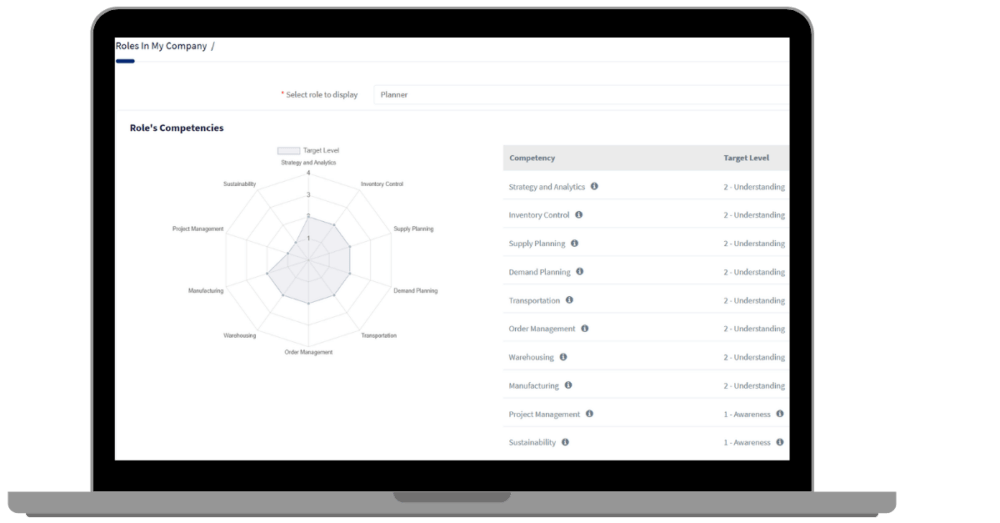
In partnership with your team, we define what 'good' looks like for all your roles using structured competency frameworks, standardising skills and proficiency expectation across regions, units, and teams.
Your role profiles are customised, with competencies and target skill levels aligned to your organization.
Skill Gap Assessment
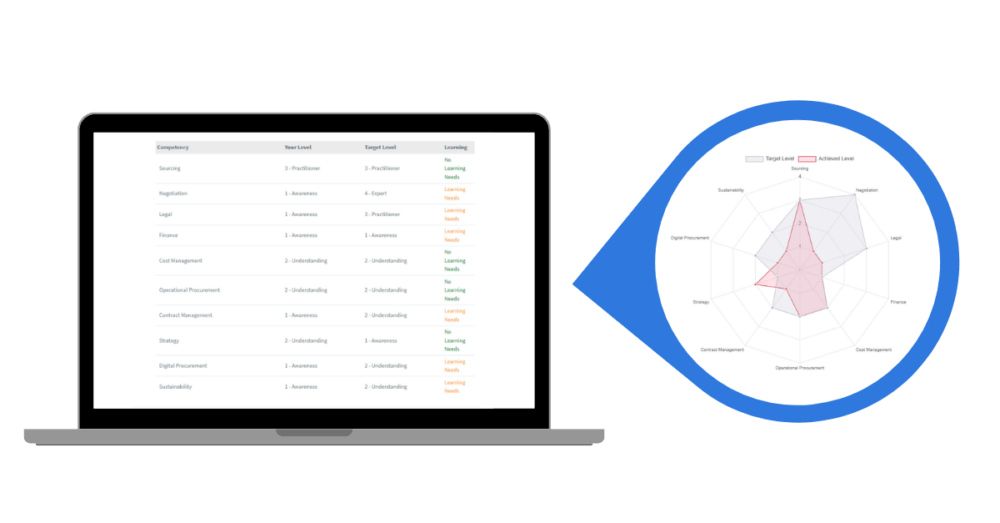
Objectively assess your team against role expectations using scenario-based assessments to identify skill gaps at an individual, team, and organizational level.
Benchmark your team members against peers and the industry standard - establishing a measurable baseline that drives personalized role-based learning and development.
Closing Capability Gaps
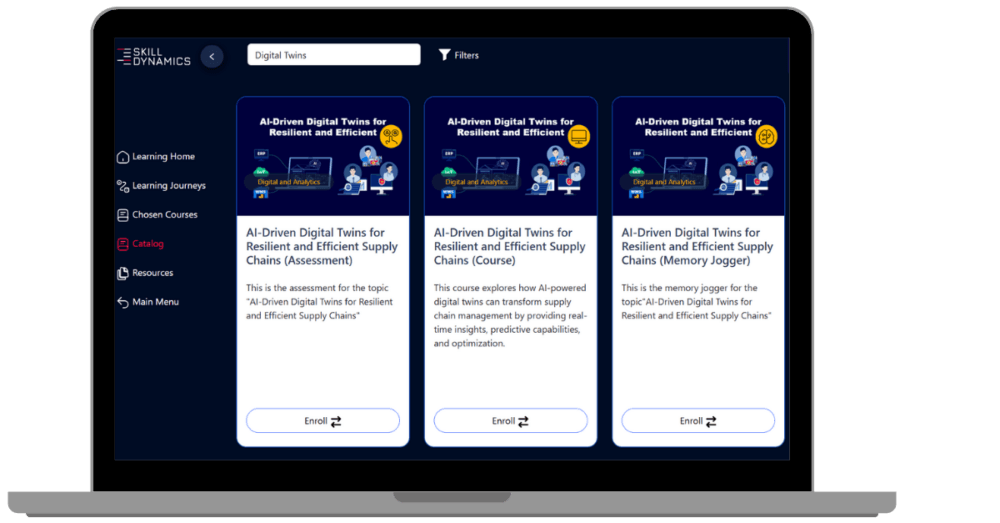
Personalized learning journeys are automatically generated based on each individual's skill gap assessment results, helping to deliver targeted learning so your team is only completing courses relevant to their own skill gaps.
Learning journeys utilize multiple formats to suit different learning styles and maintain engagement, these include eLearning courses, simulations, microlearning, knowledge assessments, and our new AI Learning Suite of AI roleplays, podcasts, and expert chat.
Content is continually refreshed to reflect emerging trends, regulations, and best practices.
Measuring Impact
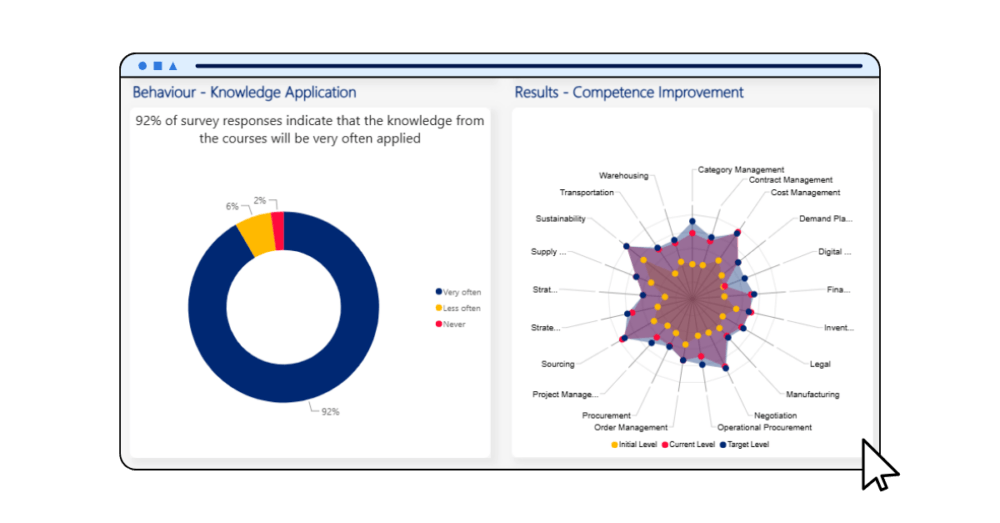
Managers can track learner engagement and adoption at an individual, team, and business level - measuring competency improvement overtime against individual initial assessment baselines.
Visualize the organizational capability through dashboards. Identify remaining skill gaps and future development priorities. Monitor learner satisfaction and learning effectiveness.
Measurable capability improvement allows you to demonstrate ROI more effectively.





Frequently Asked Questions
Most organisations can begin rollout within weeks, with deployment scaled progressively across regions, functions, and supply chain teams.
Yes. Training can be aligned to your operational environment, supply chain processes, and organisational priorities.
Capability is measured through assessments, benchmarking, engagement tracking, and reporting that provide visibility into individual and organisational progress.
Yes. Many organisations use the academy to develop capability across planning, procurement, logistics, and broader supply chain functions.
Structured learning pathways, common competency frameworks, and centralised reporting help maintain consistency across global operations.
Managers and leadership teams have access to real-time dashboards, capability insights, progress tracking, and certification records.
Speak With a Supply Chain Learning Specialist
FMCG supply chains require more than systems and processes. They require consistent capability across planning, inventory management, logistics, and operational decision-making.
Skill Dynamics helps global organisations build supply chain capability that improves forecast accuracy, strengthens operational performance, and supports better decision-making across fast-moving environments.
If you’re looking to strengthen supply chain performance across your organisation, now is the time to take a structured approach.
Request a consultation with a supply chain learning specialist
Contact Us